 Hail
Hail
Class 1 vs. Class 4: What Hail Impact Ratings Actually Mean for Your Roof
Not All Impact-Resistant Shingles Are Equal: A Guide to Class 1–4 Ratings If you’ve had a roof replaced...
Read More

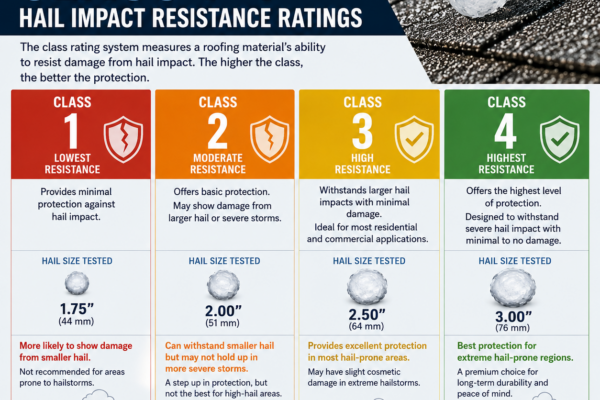
In our last post, we broke down the UL 2218 impact resistance rating scale — Class 1 through Class 4 — and why Class 4 is the right target for Texas homeowners. If you missed it, the short version: Class 4 is the highest rating the UL 2218 test currently offers, and in a state that sees hail the way Central Texas does, it’s the minimum worth asking for.
But here’s where it gets interesting. What happens when a manufacturer isn’t satisfied with hitting the top of the existing scale?
That’s the question TAMKO answered with HailGuard™ — and the answer has some genuinely meaningful implications for homeowners in hail-prone markets like Austin, San Antonio, and Dallas.
TAMKO markets HailGuard™ as “Beyond Class 4” — and to their credit, they’re upfront about what that phrase means and what it doesn’t.
It is not a new UL classification. The UL 2218 testing standard currently has no rating above Class 4. “Beyond Class 4” is a marketing term, and TAMKO discloses that clearly in their product documentation.
What it does refer to is this: TAMKO tested HailGuard™ shingles at impact energies that exceed the UL 2218 Class 4 threshold — meaning the shingles were subjected to more force than what Class 4 testing requires, and they passed. The official UL rating is still Class 4, because that’s where the ceiling of the current system sits. But HailGuard™ shingles have been put through impacts the Class 4 test doesn’t require.
That distinction matters. A lot of products carry a Class 4 label. This one was engineered to perform beyond what that label actually tests for.
The performance behind HailGuard™ starts at the material level with TAMKO’s proprietary ImpactCore™ technology — a next-generation construction approach that combines advanced polymers, a proprietary asphalt formulation, and reinforced fiberglass mat engineering.
The design intent is to absorb and disperse impact energy rather than concentrating stress at a single point — which is how traditional shingles fail. When hail hits a conventional shingle, the energy focuses on the impact zone and radiates outward, cracking the asphalt or fracturing the mat underneath. ImpactCore™ is engineered to spread that energy through the shingle system rather than concentrating it.
The result, according to TAMKO’s testing: granules hold firm, the sealant maintains grip, the laminate stays intact, and the reinforcement layer keeps the system together under impacts that would compromise conventional Class 4 products.
Here’s what no other asphalt shingle manufacturer was offering before HailGuard™: a warranty that covers hail damage.
As of March 2026, TAMKO HailGuard™ is the first and only asphalt shingle system backed by an Extended Hail Warranty. Every other Class 4 shingle on the market — regardless of what the label says — excludes hail from its warranty coverage. That’s standard across the industry. Shingles are rated for impact resistance, but if hail actually damages them, you’re relying on your homeowner’s insurance, not the manufacturer.
HailGuard™ changes that. When installed as a qualifying complete system by a TAMKO-certified contractor, the warranty covers leaks caused by hail up to 3 inches in diameter for up to 20 years.
To be precise about the full coverage picture:
The hail and wind coverages require installation as part of the TAMKO Complete® roofing system by a contractor enrolled in TAMKO’s Edge® contractor program. This isn’t just a shingle swap — it’s a system-based installation with specified underlayments and accessories. That’s intentional: the warranty is backed by the full system performing as designed, not just the shingle in isolation.
Central Texas homeowners file more hail-related insurance claims per capita than homeowners in most other regions of the country. The storms here are frequent, and the hailstones are often large — 1-inch stones are common, 2-inch events happen every season across the I-35 corridor.
Most of those claims go through homeowner’s insurance, with deductibles that can run $2,500 to $10,000 or more depending on the policy. A warranty that covers hail leaks — backed by the manufacturer, not your insurer — is a fundamentally different kind of protection than what the rest of the market offers.
Beyond the warranty itself, TAMKO notes that some insurance carriers may offer premium discounts for homes with impact-rated roofing. This isn’t guaranteed, and availability varies by insurer and location, but Class 4 discounts of 20–35% are common in Texas. As always, check with your insurance agent for what applies to your specific policy.
“Beyond Class 4” is a marketing term — TAMKO says so themselves. But the underlying story is legitimate: HailGuard™ shingles were tested at impact energies above what the Class 4 standard requires, built with purpose-designed technology to manage hail impact, and — most importantly — backed by the only hail warranty in the asphalt shingle market.
For homeowners in Austin, San Antonio, Dallas, and across Central Texas, those aren’t small distinctions. Hail isn’t an occasional risk here. It’s a seasonal expectation. The question isn’t whether your roof will face it — it’s whether your roof was built to handle it, and whether your protection goes beyond hoping your insurance claim gets approved.
HailGuard™ is the only asphalt shingle product where the manufacturer shares that risk with you directly.
Dimensional Roofing & Diagnostics installs and recommends products based on independent performance data and real-world suitability for Central Texas conditions. If you’re interested in learning more about TAMKO HailGuard™ or whether it’s the right fit for your home, reach out — we’re happy to walk through the details.
Guidance designed to help homeowners and property owners make informed decisions.
Hail
Not All Impact-Resistant Shingles Are Equal: A Guide to Class 1–4 Ratings If you’ve had a roof replaced...
Read More