
 Hail
Hail
TAMKO HailGuard: The Only Asphalt Shingle That Actually Warranties Against Hail
Class 4 Was the Ceiling. TAMKO’s HailGuard Went Through It. In our last post, we broke down the...
Read More

If you’ve had a roof replaced in Texas, you’ve probably heard the term “impact-resistant shingles.” Maybe your contractor mentioned them, or your insurance company offered a discount for having them installed. But what does “impact-resistant” actually mean — and does the shingle on your roof live up to that label?
The answer depends on which class of impact resistance it’s rated for. Here’s what the rating system actually measures, and why it matters more in Texas than almost anywhere else in the country.
The impact resistance rating most commonly referenced in the roofing industry comes from UL 2218, a test standard developed by Underwriters Laboratories. The test simulates hail impact by dropping steel balls of increasing size from increasing heights onto a shingle sample. If the shingle doesn’t crack or fracture when struck twice in the same spot, it passes for that class.
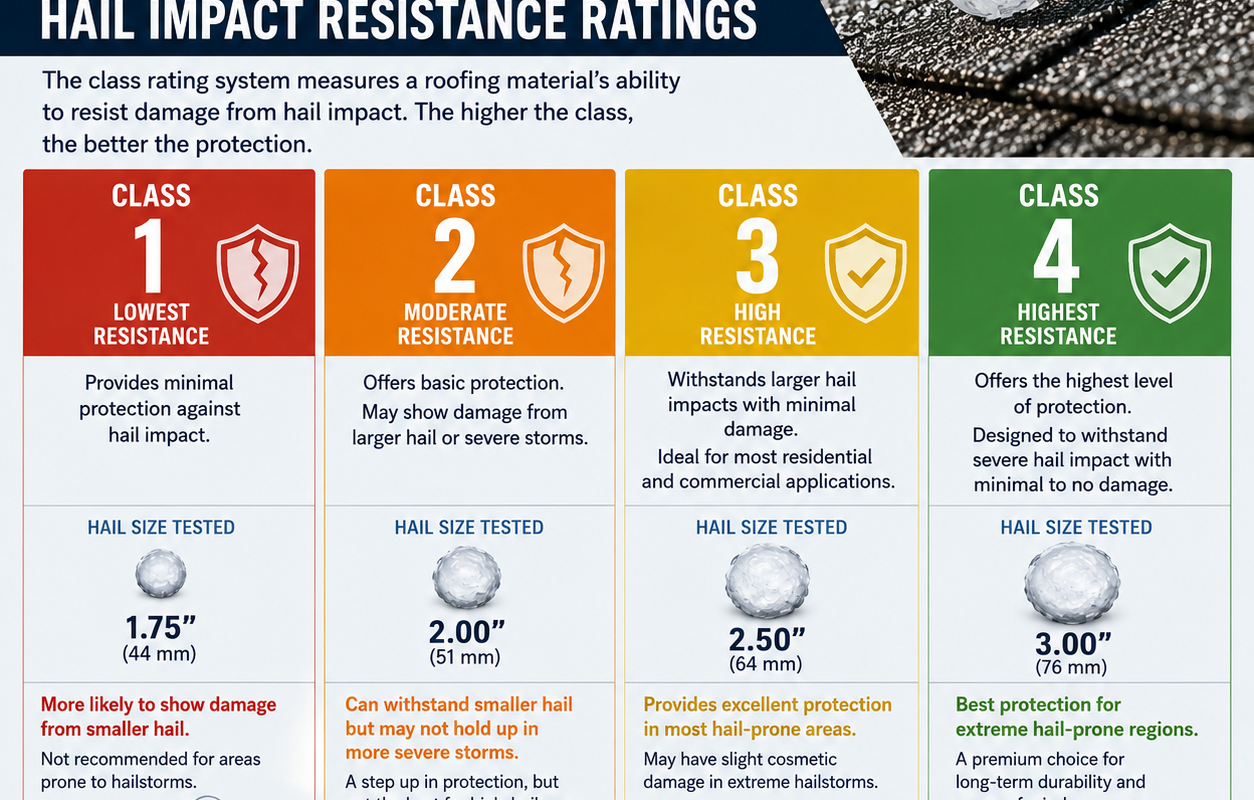
The ball size approximates hail diameter. The drop height approximates the impact energy of falling ice at terminal velocity. There are four classes:
| Class | Steel Ball Diameter | Drop Height | Approximate Hail Equivalent |
| Class 1 | 1.25 inches | 12 feet | ~1.25″ diameter hail |
| Class 2 | 1.50 inches | 15 feet | ~1.50″ diameter hail |
| Class 3 | 1.75 inches | 17 feet | ~1.75″ diameter hail |
| Class 4 | 2.00 inches | 20 feet | ~2.00″ diameter hail |
Class 4 is the highest rating achievable under UL 2218. A shingle that earns it didn’t crack when struck by a 2-inch steel ball dropped from 20 feet — twice, in the same spot.
Texas is one of the most hail-prone states in the country. The corridor along I-35 — running through San Antonio, Austin, and Dallas — sits within what meteorologists call “Hail Alley,” a region where warm Gulf moisture collides with cold fronts from the north with enough frequency and intensity to produce large hail events year after year.
Hailstorms producing stones 1 inch in diameter or larger are a regular occurrence across Central Texas from spring through early summer. That’s the context in which you’re selecting a shingle. A product that passes at Class 1 or Class 2 is rated to handle considerably smaller and slower impacts than what Texas storms routinely produce.
That risk calculus isn’t lost on insurance companies. Most Texas carriers offer a premium discount of 20–35% for homes with verified Class 4 impact-resistant roofing. The range varies by insurer and policy, but the discount reflects actuarial data: Class 4 roofs generate fewer and less severe claims.
If you’re replacing a roof in Texas and not at least asking about Class 4 shingles, you’re likely leaving money on the table — both in terms of long-term protection and immediate premium savings.
While UL 2218 is the industry standard, it tests for only one damage mode: whether a shingle cracks under impact. It doesn’t measure granule loss, surface denting, or how well the waterproofing layer holds up after repeated impacts — all of which matter when you’re evaluating long-term performance.
The Insurance Institute for Business & Home Safety (IBHS) runs its own independent testing program that goes beyond what UL 2218 captures. IBHS purchases shingles directly from retail stores (not from manufacturer-supplied samples), replicates realistic hail impacts in controlled conditions, and measures multiple damage types: granule loss, surface cracking, denting, and waterproofing integrity.
The result is a more complete performance picture than a binary pass/fail result. Their ratings allow homeowners and contractors to compare shingles within the same class — because two products can both carry a Class 4 rating under UL 2218 and perform very differently when tested under IBHS methodology.
You can explore IBHS’s current ratings at ibhs.org/hail-impact-resistant-shingle-ratings. If you’re investing in a Class 4 roof, it’s worth cross-referencing the IBHS scorecard before settling on a product.
A number of major manufacturers produce shingles that achieve Class 4 impact resistance under UL 2218. Some of the most widely specified in Texas include:
Product lines and formulations change, so always verify current ratings directly with the manufacturer and cross-reference IBHS performance data before finalizing a product selection.
Class 4 is the right target for Texas homeowners — but a Class 4 label alone isn’t the end of the conversation. The UL 2218 test tells you a shingle survived a controlled impact. IBHS data tells you how it actually performs under conditions that more closely resemble a real storm.
Use both. Ask your contractor which specific product they’re recommending, what its Class rating is, and where it lands on the IBHS scorecard. A contractor who can answer that question with specifics — not just “it’s impact-resistant” — is one who’s done their homework.
At Dimensional Roofing & Diagnostics, we recommend products based on independent performance data, not contractor incentives. If you have questions about which shingles make sense for your home and your insurance situation, reach out — we’re happy to walk through the options.
Guidance designed to help homeowners and property owners make informed decisions.
Hail
Class 4 Was the Ceiling. TAMKO’s HailGuard Went Through It. In our last post, we broke down the...
Read More