

 Diagnostics
Why We Bring a Drone to Every Roof Inspection (And What It Sees That You Can’t)
Beyond the Naked Eye: The Technology Behind Every Dimensional Roofing Inspection Most roofing companies send someone up a...
Read More

When a property owner has a leak, the first instinct is almost always to blame the roof. Sometimes that’s right. Often, it isn’t. One of the most common things we find during an inspection is that the roof is doing its job just fine — the water is getting in somewhere else. That’s why we evaluate the whole building envelope, not just shingles or membrane.
The building envelope is every exterior system separating the inside of a structure from the outside world: roofing, exterior walls, flashing and penetrations, windows and doors, drainage systems, expansion joints, and mechanical transitions. Each piece has one job: to keep water and moisture out. When one fails, water finds a way in, and because these systems overlap, it doesn’t always enter where the stain shows up.
A roofer who checks only the deck and shingles can rule out the roof, but that doesn’t solve a recurring leak. Water travels… it can enter through a wall penetration two stories up and track along framing before it ever shows indoors. If the inspection stops at the roofline, the real source often gets missed, and the “fixed” leak comes back.
Roof-to-wall transitions, where a roofline meets a second-story wall or dormer, are common failure points once flashing deteriorates. Window and door flashing can fail after years of Central Texas heat and UV exposure, even on a well-installed window. Attic moisture without an obvious roof leak often traces back to a vent, wall penetration, or chimney flashing rather than the roofing material itself.
Larger buildings add complexity. Low-slope roofs depend on drainage design. Ponding water or a clogged scupper pushes moisture toward weak points in the membrane and nearby walls. Parapet walls and expansion joints are frequent intrusion points once coping caps or sealants age out. Mechanical penetrations: HVAC curbs, conduit, plumbing stacks multiply potential entry points. On multi-family properties, a leak that seems to move between units is often an envelope issue, a pattern we regularly help HOAs and property managers track down.
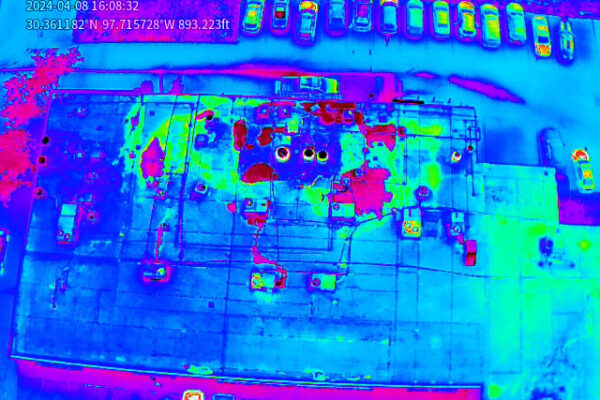
We widen the inspection rather than narrowing it, examining the roof alongside surrounding walls, flashing, drainage paths, and penetrations, using infrared drone technology and thermal photography to spot moisture that isn’t visible to the eye. The goal isn’t just finding where water is getting in, but why, so the fix holds.
Consider a broader evaluation if a leak has been “fixed” more than once in the same area, water shows up without an obvious roof cause, you’re seeing wall staining or musty odors, leaks have appeared in more than one unit or bay, or your building has aging parapets, expansion joints, or a low-slope roof.
Whether it’s a single-family home or a 200-unit complex, the principle is the same: the roof is one part of a larger system. Schedule a building envelope evaluation with our team.
Guidance designed to help homeowners and property owners make informed decisions.
Diagnostics
Beyond the Naked Eye: The Technology Behind Every Dimensional Roofing Inspection Most roofing companies send someone up a...
Read More